

Comparison of Types of Cash Value Life Insurance
Cash value life insurance offers lifelong coverage along with a built-in savings component. But not all cash value policies work the same way. Whole life, variable life, universal life, and variable universal life insurance each offer different levels of control, guarantees, and flexibility.
This comparison of types of cash value life insurance breaks down the key features side by side, so Fort Myers and Southwest Florida policyholders can understand exactly how each option functions before choosing a policy.
What Is Cash Value Life Insurance?
Cash value life insurance is a type of permanent life insurance that combines death benefit protection with a savings component. A portion of every premium payment goes toward building cash value, which grows over time on a tax-deferred basis.
Policyholders can access this accumulated cash value through withdrawals or policy loans. However:
- Unpaid loans and withdrawals may reduce both the cash value and the death benefit.
- Surrender charges and income taxes may apply in certain situations.
- If the policy is classified as a modified endowment contract (MEC), early withdrawals may also be subject to penalties.
The main types of cash value life insurance are whole life, universal life, variable life, and variable universal life insurance — each offering a different balance of guarantees, flexibility, and investment control.
Comparison of Cash Value Life Insurance Types
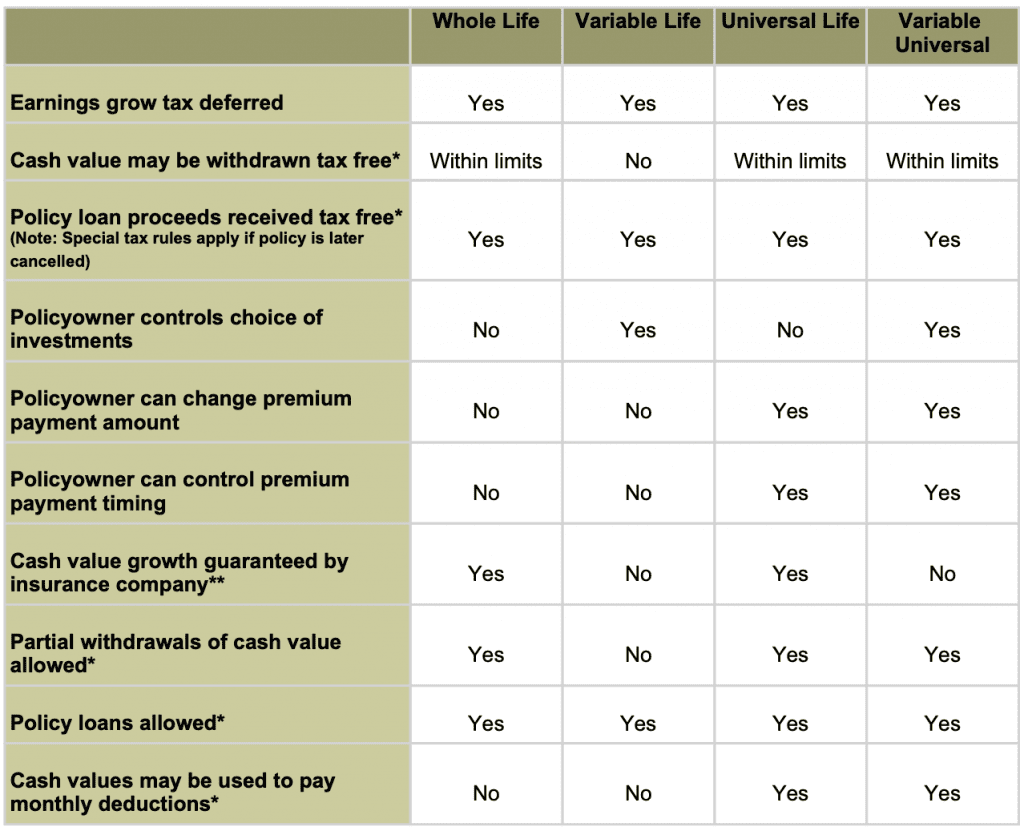
The table below compares how whole life, variable life, universal life, and variable universal life insurance handle key policy features.
Whole Life Insurance: Guaranteed but Fixed
Whole life insurance offers guaranteed cash value growth, along with the ability to withdraw cash value within limits and take policy loans. However, the policyholder has no control over investment choices, premium amount, or premium timing — everything is fixed by the insurer.
Variable Life Insurance: Investment Control, No Guarantees
Variable life insurance gives the policyholder control over investment choices, allowing cash value to be placed into market-based subaccounts. In exchange for this control:
- Cash value growth is not guaranteed by the insurance company.
- Cash value cannot be withdrawn tax free.
- Partial withdrawals of cash value are not allowed.
- Policy loans are still allowed.
Universal Life Insurance: Flexible Premiums, Guaranteed Growth
Universal life insurance allows the policyholder to change both the premium payment amount and timing, offering more flexibility than whole life. It also guarantees cash value growth. Universal life policyholders can:
- Withdraw cash value within limits, tax free.
- Take partial withdrawals of cash value.
- Take policy loans.
- Use cash values to pay monthly deductions.
The one feature universal life does not offer is policyholder control over investment choices.
Variable Universal Life Insurance: Maximum Flexibility, No Growth Guarantee
Variable universal life insurance combines the flexibility of universal life with the investment control of variable life. Policyholders can:
- Control investment choices.
- Change premium payment amount and timing.
- Withdraw cash value within limits, tax free.
- Take partial withdrawals and policy loans.
- Use cash values to pay monthly deductions.
The trade-off is that, like variable life insurance, cash value growth is not guaranteed by the insurance company — it depends on the performance of the chosen investment subaccounts.
Which Cash Value Life Insurance Features Matter Most?
When comparing these policy types, consider:
- Guarantees: Whole life and universal life offer guaranteed cash value growth; variable life and variable universal life do not.
- Investment control: Only variable life and variable universal life allow the policyholder to choose investments.
- Premium flexibility: Only universal life and variable universal life allow the policyholder to change premium amount and timing.
- Access to cash value: Policy loans are allowed across all four types, though rules on tax-free withdrawals and partial withdrawals vary.
To better understand how cash value works inside a policy, read: What Is Cash Value Life Insurance? Learn How It Works
Frequently Asked Questions
What are the main types of cash value life insurance?
The main types are whole life, variable life, universal life, and variable universal life insurance. Each differs in guarantees, investment control, and premium flexibility.
Which type of cash value life insurance guarantees cash value growth?
Whole life and universal life insurance both guarantee cash value growth by the insurance company. Variable life and variable universal life insurance do not offer this guarantee.
Can I choose my own investments with cash value life insurance?
Only variable life and variable universal life insurance allow the policyholder to control investment choices. Whole life and universal life do not offer this option.
Which cash value life insurance policies allow me to change my premium payments?
Universal life and variable universal life insurance both allow the policyholder to change the premium payment amount and control payment timing. Whole life and variable life do not.
Can I take a loan against any type of cash value life insurance policy?
Yes. Policy loans are allowed under whole life, variable life, universal life, and variable universal life insurance.
Can cash value be used to pay monthly policy deductions?
Universal life and variable universal life insurance allow cash value to be used to pay monthly deductions. Whole life and variable life do not offer this feature.


