

Disability Income Protection in Florida
The "No Loopholes" Approach to Disability Income Insurance
Your ability to earn an income is likely your single greatest financial asset — more valuable, over a working lifetime, than your home or your investment portfolio. Disability income protection insurance is designed to replace a portion of that income if illness or injury prevents you from working. Based in Fort Myers, we help business owners, physicians, dentists, attorneys, CPAs, executives, and other professionals throughout Southwest Florida evaluate individual disability insurance policies built around strong contract language rather than marketing promises — what we call a “no loopholes” approach: policies scrutinized for exclusions, definitions, and renewal terms before you ever need to file a claim.
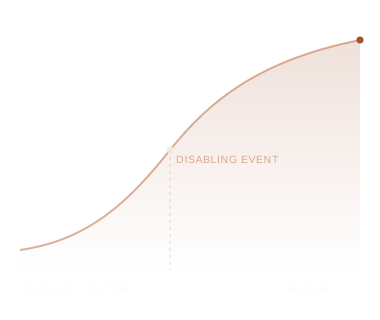
Income earning potential across a working lifetime
What Is Disability Income Protection Insurance?
Disability income protection insurance (also called disability income insurance or DI insurance) is a contract that pays a monthly benefit, typically a percentage of your prior income, if you become unable to work due to a covered illness or injury. Unlike workers’ compensation, which only applies to on-the-job injuries, individual disability income insurance can cover disabling events that occur anywhere, at any time, whether or not they’re work-related.
How Does Disability Income Insurance Work?
When a policyholder becomes disabled as defined by their contract, they typically satisfy an elimination period (a waiting period, often 30–180 days) before benefits begin. Once benefits start, the insurer pays a monthly amount — usually 40–70% of pre-disability income — for a defined benefit period, which may range from a few years to age 65 or, in some legacy contracts, for life. The specific triggers for a claim, the definition of “disabled,” and the length and amount of benefits vary significantly from policy to policy, which is why contract language matters more than the premium quoted.
Anatomy of a Claim
Elimination Period
Benefit Period

What to Look for in a Disability Insurance Policy
Not all disability insurance is written the same way, and group, association, and individual disability contracts can differ substantially in the protections they provide. Below are the features we believe matter most when comparing disability income protection options.
Non-Cancelable & Guaranteed Renewable
This feature guarantees that the insurance company cannot cancel your coverage, raise your premiums, or change any provisions of your contract, helping protect long-term financial security. (Group long-term disability and association plans typically lack this guarantee.)
Lifetime Benefit Period
Since most people need income for as long as they live, a lifetime benefit period is one of the strongest protections available. This feature has not been widely offered in individual contracts for over a decade, which is worth noting when reviewing any in-force policy.
No Exclusions
Most disability contracts carry at least one exclusion. Common exclusions include war (declared or undeclared), pregnancy, incarceration, self-inflicted injury, mental illness, air travel, and disabilities occurring outside the U.S., with many policies requiring the insured to be stateside to administer a claim.
Only Loss of Income Required
Ideally, the only requirement to begin the waiting period and receive benefits is a loss of income due to disability — not a loss of time at work or a loss of specific job duties.
Total Disability Not Required
A period of “total disability” should never be a prerequisite for partial, full, or lifetime benefits. In fact, the term “total disability” arguably shouldn’t appear in the policy at all — most disabilities, statistically, are partial.
Partial Disability Benefit
Partial disability is the most common type of disabling event, and the resulting partial loss of income should be covered.
Cost of Living / Inflation Protection
While disabled, benefits should increase annually on a compounded basis to help offset inflation. Without this feature, purchasing power erodes the longer a claim continues.
Guaranteed Increase Agreement
A strong policy allows the insured to increase coverage in the future regardless of any change in health.
Own-Occupation Protection
Under true own-occupation disability insurance, benefits are payable if you can no longer work in your own occupation or specialty — even if you choose to work in a different occupation. This differs from any-occupation disability insurance, which only pays if you cannot work in any occupation for which you are reasonably suited by education, training, or experience. Own-occupation coverage is particularly important for physicians, dentists, attorneys, and other professionals whose income depends on specialized skills.
HIV Agreement
Some policies consider an insured disabled if they become HIV-positive and are legally prevented — by regulation or an inability to obtain malpractice insurance — from performing their occupation.
Group and association disability plans rarely include more than two or three of the protections above, which is one reason many professionals and business owners layer individual disability income insurance on top of employer-provided group coverage.
Short-Term vs. Long-Term Disability Insurance
Short-Term Disability Insurance
Short-term disability insurance typically covers a portion of income for a limited period — often a few months up to a year — following an elimination period as short as one to fourteen days. It’s designed to bridge income during shorter recoveries, such as a surgery or a difficult pregnancy.
Long-Term Disability Insurance
Long-term disability insurance applies after a longer elimination period (commonly 90 or 180 days) and can pay benefits for years, to a specified age such as 65, or, in some older contracts, for life. Long-term coverage is generally the more significant planning consideration for business owners and professionals, since it addresses the financial impact of an extended or permanent inability to work.
Many comprehensive income protection strategies combine short-term coverage (through an employer or a standalone policy) with an individual long-term disability policy to avoid coverage gaps.
Other Valuable Policy Features to Consider
Catastrophic Rider
Allows the lack of activities of daily living (ADLs) to serve as a claim trigger, which may better fit certain disabling circumstances and can allow for a more liberal claim.
Business Loan Protector
Protects against existing outstanding debt service if a business owner is unable to generate the revenue that would have otherwise covered those obligations.
Business Overhead Expense (BOE) Insurance
Business overhead expense disability insurance reimburses the fixed costs of running a business — rent, utilities, subscriptions, equipment leases, and similar overhead — so the business can remain a going concern while the owner is disabled and unable to generate revenue. BOE coverage is distinct from personal income replacement disability insurance, which protects the owner’s own paycheck rather than the business’s operating costs.
Retirement Protection
Provides for continued contributions toward retirement savings during a disability, so long-term retirement goals aren’t derailed by a claim.
Disability Income Insurance for Business Owners
Business owners face a dual exposure that employees typically don’t: a disability can interrupt both personal income and the business’s ability to operate. A layered approach often includes:
Because small business owners in Southwest Florida often don’t have access to employer-sponsored group long-term disability coverage, individually underwritten policies with strong contract provisions — non-cancelable, guaranteed renewable, own-occupation — are frequently the primary form of protection available.
Individual disability income insurance to replace personal income.
Business overhead expense insurance to keep the business’s fixed costs covered.
Business loan protection where the business carries meaningful debt.
Buy-sell funding considerations for multi-owner businesses, so a disabled owner’s interest can be addressed without destabilizing the company.
Disability Insurance for Professionals
Physicians, dentists, attorneys, CPAs, and other licensed professionals typically have significant income tied directly to specialized skills and licensure, which makes true own-occupation disability insurance especially relevant. A surgeon who can no longer operate, for example, may still be able to teach or consult — under a strong own-occupation contract, that transition doesn’t eliminate the disability benefit. Professionals should also evaluate:
Income
Coverage amounts relative to current and projected future income, since many contracts cap coverage as a percentage of income.
Growth
Guaranteed increase options that allow coverage to grow with income over time without new medical underwriting.
Limitations
Association and group plan limitations, since many professional associations offer disability coverage that lacks non-cancelable or guaranteed renewable protection.
Serving Business Owners and Professionals Throughout Southwest Florida
Based in Fort Myers, we work with business owners and professionals across Southwest Florida on disability income protection planning, including:
As a Southwest Florida disability insurance broker, we’re not captive to a single carrier — this allows for a comparison of contract provisions across multiple insurers rather than a single company’s offering, when evaluating which company and policy design may best fit an individual’s or business’s circumstances.
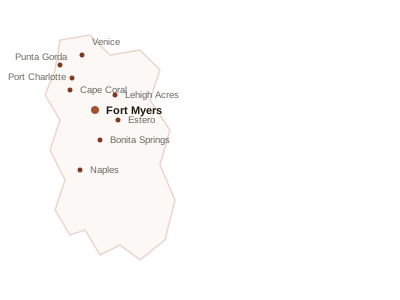
| Fort Myers | Cape Coral | Naples |
| Bonita Springs | Estero | Punta Gorda |
| Port Charlotte | Venice | Lehigh Acres |
Frequently Asked Questions
What is disability income protection insurance?
Disability income protection insurance is a contract that replaces a portion of your income if you become unable to work due to a covered illness or injury. Individual policies are underwritten based on your health, occupation, and income, and the terms of the contract determine when and how benefits are paid.
How does disability income insurance work?
After a disabling event, the insured satisfies an elimination (waiting) period before benefits begin. Benefits are then paid monthly, generally as a percentage of prior income, for a defined benefit period specified in the contract, subject to the policy’s definition of disability and any applicable exclusions.
What is the difference between short-term and long-term disability insurance?
Short-term disability insurance covers a limited period, often several months, following a brief waiting period, while long-term disability insurance applies after a longer waiting period and can pay benefits for years or, in some contracts, to a specified retirement age.
What is own-occupation disability insurance?
Own-occupation disability insurance pays benefits if you can no longer perform the material duties of your own specific occupation, even if you’re able to work in a different occupation. This differs from any-occupation coverage, which requires that you be unable to perform any occupation you’re reasonably suited for.
What is business overhead expense (BOE) insurance?
Business overhead expense insurance reimburses a business’s ongoing fixed operating costs — such as rent, utilities, and equipment leases — if the owner becomes disabled and unable to generate revenue, helping keep the business operational during the owner’s recovery.
What does “non-cancelable” and “guaranteed renewable” mean?
A non-cancelable and guaranteed renewable policy means the insurance company cannot cancel the coverage, raise premiums, or change contract terms as long as premiums are paid on time. Many group and association disability plans do not carry this guarantee.
Is disability insurance available for self-employed professionals?
Yes. Self-employed professionals and small business owners without access to employer-sponsored group disability coverage are often candidates for individually underwritten disability income insurance, which can be tailored around income, occupation, and specific business risks such as overhead expenses.
This content is educational and general in nature. It is not a guarantee of coverage, benefits, or claims outcomes, and individual eligibility, terms, and pricing are determined through underwriting. Please consult a licensed professional for guidance specific to your situation.
Have a Question About Disability Income Protection? Contact Us
Ready to review your disability income protection options in Florida? Contact our Fort Myers office at (239) 489-0084 or complete the form below to schedule a conversation about your coverage.


