

Comparison of Types of Life Insurance
Understanding the differences between the main types of life insurance can help you compare how each policy handles premiums, coverage, death benefits, cash value, policy loans, and withdrawals.
The five policy types compared below are:
- Term Life Insurance
- Whole Life Insurance
- Universal Life Insurance
- Variable Life Insurance
- Variable Universal Life Insurance
Each type has different features. Some offer coverage for a specific period, while others provide lifetime coverage. Premium flexibility, death benefits, cash value growth, and access to policy loans or withdrawals can also vary.
Types of Life Insurance Comparison at a Glance
The following comparison highlights the key differences between term, whole, universal, variable life, and variable universal life insurance.
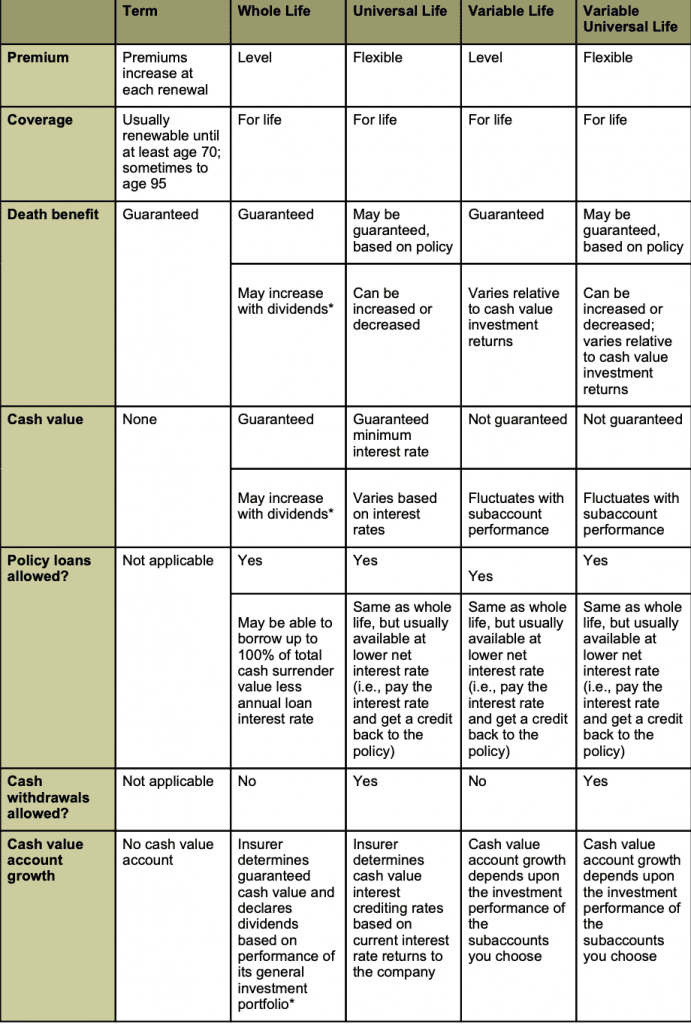
Term vs. Whole vs. Universal Life Insurance
Term Life Insurance
Term life insurance generally provides coverage for a limited period rather than for life. The policy is usually renewable until at least age 70 and, in some cases, until age 95.
Premiums increase at each renewal. Term life insurance does not have a cash value account, and policy loans and cash withdrawals are not applicable.
The death benefit is guaranteed according to the terms of the policy.
Whole Life Insurance
Whole life insurance provides coverage for life and generally has level premiums. Its death benefit is guaranteed and may increase with dividends.*
Whole life insurance includes guaranteed cash value. The insurer determines the guaranteed cash value and may declare dividends based on the performance of its general portfolio.*
Policy loans are allowed. Depending on the policy, it may be possible to borrow up to 100% of the total cash surrender value, less annual loan interest.
Cash withdrawals are not allowed.
Universal Life Insurance
Universal life insurance provides lifetime coverage and offers flexible premiums. Depending on the policy, the death benefit may be guaranteed and can potentially be increased or decreased.
Universal life policies have a guaranteed minimum interest rate for cash value. The actual cash value can vary based on interest rates.
Policy loans and cash withdrawals are allowed. Loans may be available at a lower net interest rate, depending on the policy terms.
Variable Life Insurance
Variable life insurance provides lifetime coverage and generally has level premiums. The death benefit is guaranteed but can vary relative to cash value investment returns.
Unlike whole or universal life insurance with guaranteed cash value features, variable life insurance does not guarantee cash value. Cash value fluctuates based on the performance of the investment subaccounts you choose.
Policy loans are allowed, while cash withdrawals are not allowed.
Variable Universal Life Insurance
Variable universal life insurance provides lifetime coverage and combines flexible premiums with investment-based cash value growth.
Depending on the policy, the death benefit may be guaranteed and can be increased or decreased. It may also vary relative to the investment returns of the selected subaccounts.
Cash value is not guaranteed and fluctuates according to the performance of the subaccounts you choose.
Both policy loans and cash withdrawals are allowed, subject to the terms and conditions of the policy.
Life Insurance Cash Value Comparison
One of the main differences between these types of life insurance is how cash value works.
- Term life insurance has no cash value account.
- Whole life insurance provides guaranteed cash value and may increase with dividends.*
- Universal life insurance provides a guaranteed minimum interest rate, while actual cash value can vary based on interest rates.
- Variable life insurance does not guarantee cash value because growth depends on the performance of selected investment subaccounts.
- Variable universal life insurance also has non-guaranteed cash value that fluctuates based on subaccount performance.
For individuals and families in Florida, comparing these policy features can help clarify the differences between life insurance options before considering which type may align with their financial objectives.
Comparing Policy Loans and Cash Withdrawals
Access to policy loans and cash withdrawals also differs by policy type.
Term life insurance does not provide a cash value account, so policy loans and withdrawals are not applicable.
Whole, universal, variable, and variable universal life insurance allow policy loans. However, the availability and terms of loans can vary by policy.
Cash withdrawals are allowed with universal life and variable universal life insurance. Whole life and variable life insurance do not allow cash withdrawals according to this comparison.
Policy loans and withdrawals can reduce both the policy’s cash value and death benefit and may cause the policy to lapse.
Key Takeaway: Comparing the Main Types of Life Insurance
The primary differences between the main types of life insurance involve:
- How premiums are structured
- Whether coverage is temporary or for life
- Whether the death benefit is guaranteed or can vary
- Whether the policy includes cash value
- How cash value can grow
- Whether policy loans are available
- Whether cash withdrawals are allowed
Term life insurance has no cash value and generally provides coverage for a specified period. Whole, universal, variable, and variable universal life insurance provide lifetime coverage, but they differ in premium flexibility, death benefit structure, cash value guarantees, and investment-related performance.
When comparing life insurance options in Florida or elsewhere, reviewing the specific policy terms is important because guarantees, loans, withdrawals, interest crediting, and investment performance can differ from one policy to another.
Frequently Asked Questions
What are the main types of life insurance?
The main types compared here are term life, whole life, universal life, variable life, and variable universal life insurance.
What is the main difference between term and whole life insurance?
Term life insurance generally provides coverage for a limited period and does not build cash value. Whole life insurance provides coverage for life, generally has level premiums, and includes guaranteed cash value.
Which types of life insurance have flexible premiums?
Universal life insurance and variable universal life insurance offer flexible premiums.
Which life insurance policies have cash value?
Whole life, universal life, variable life, and variable universal life insurance have cash value features. Term life insurance does not have a cash value account.
Is cash value guaranteed for every type of permanent life insurance?
No. Whole life insurance has guaranteed cash value, and universal life insurance includes a guaranteed minimum interest rate. Variable life and variable universal life insurance do not guarantee cash value because it depends on investment subaccount performance.
Which types of life insurance allow policy loans?
According to this comparison, whole life, universal life, variable life, and variable universal life insurance allow policy loans. Term life insurance does not have policy loans because it does not have a cash value account.
Which life insurance policies allow cash withdrawals?
Universal life and variable universal life insurance allow cash withdrawals. Cash withdrawals are not applicable to term life insurance and are not allowed for whole life or variable life insurance in this comparison.


