

Life Insurance Retirement Plan in Florida: How It Works
A life insurance retirement plan (LIRP) is a permanent, cash value life insurance policy structured to protect your family with a death benefit and build cash value you can access later as supplemental retirement income. In Florida, ASOFSP in Fort Myers uses an approach called LIRP Plus to combine both goals in one policy.
Key Takeaways
- A LIRP is a permanent life insurance policy that pairs a death benefit, generally income tax-free to beneficiaries, with cash value that grows tax-deferred.
- Cash value can generally be accessed in retirement through tax-free withdrawals (up to basis) and policy loans, when the policy is structured and managed properly.
- A LIRP is typically used alongside a 401(k), not instead of it.
- Costs are typically higher than IRA fees, and withdrawals or loans can reduce the death benefit or cause a lapse.
Table of Contents
- What Is a Life Insurance Retirement Plan (LIRP)?
- How Does a Life Insurance Retirement Plan Work?
- Why Consider Life Insurance for Retirement in Florida?
- What Does a Permanent Life Insurance Policy Provide?
- LIRP vs. 401(k) Retirement Plan: What's the Difference?
- LIRP vs. Annuity: What's the Difference?
- Hypothetical Case Study: How a Family Could Use LIRP Plus
- Benefits and Considerations of a LIRP
- Is a Life Insurance Retirement Plan Right for You?
- Frequently Asked Questions
What Is a Life Insurance Retirement Plan (LIRP)?
A life insurance retirement plan, often called a LIRP or “LIRP insurance,” is a permanent (cash value) life insurance policy structured to do two jobs at once. The same policy serves a protection need and a savings need.
A LIRP is designed to:
- Provide a death benefit that is generally income tax-free to your beneficiaries if something happens to you.
- Build cash value over time that you can access later as a source of retirement income.
You may also hear this approach called “life insurance for retirement,” “using life insurance as a retirement plan,” or an “insurance retirement plan.” They all describe the same idea.
At The Art and Science of Successful Planning (ASOFSP) in Fort Myers, Florida, we help individuals and families use a strategy called LIRP Plus, which combines life insurance protection with tax-advantaged retirement savings in one policy.
How Does a Life Insurance Retirement Plan Work?
You pay premiums into a permanent life insurance policy. Part of each premium builds cash value, and in retirement you can generally access that cash value through tax-free withdrawals and loans. This is one way to use life insurance in your retirement planning.
LIRP Plus is our approach to structuring a policy for retirement. The basic steps are:
- Buy a permanent policy sized for protection. The death benefit is sized to meet your family’s protection needs.
- Build cash value. Premiums you pay build cash value inside the policy over time.
- Access it in retirement. As you approach retirement and your need for a large death benefit decreases, cash value can be accessed through tax-free withdrawals and loans.
- Fill the income gap. This supplemental income can help fill a retirement income gap, alongside your 401(k), Social Security, and other savings.
For a broader look at how this fits into a full retirement strategy, see our guide on Tax-Insulated Retirement Income Strategies.
Why Consider Life Insurance for Retirement in Florida?
Florida retirees face a specific set of planning factors: no state income tax, a large retiree population, and distinct long-term care and estate planning needs. A life insurance retirement plan in Florida can be designed around these factors. Planning considerations include:- Florida’s tax-friendly treatment of retirement income.
- Long-term care cost planning specific to Southwest Florida.
- Coordinating a LIRP with other retirement accounts under Florida residency rules.
What Does a Permanent Life Insurance Policy Provide?
A permanent life insurance policy with cash value gives you more than a death benefit. Depending on how it is structured, it can offer:- Death benefit protection, generally income tax-free to your beneficiaries.
- Cash value growth that grows tax-deferred inside the policy.
- Optional riders, such as:
- A disability rider to help pay premiums during an extended disability.
- A long-term care rider that accelerates the death benefit for qualifying care expenses. This reduces the death benefit and cash value proportionately and carries additional costs.
LIRP vs. 401(k) Retirement Plan: What’s the Difference?
A 401(k) is a retirement savings account only, while a LIRP adds life insurance protection to supplemental savings. This is one of the most common questions we hear, so here is a direct comparison.| Feature | LIRP | 401(k) retirement plan |
|---|---|---|
| Primary purpose | Life insurance protection plus supplemental savings | Retirement savings only |
| Death benefit | Yes, generally tax-free to beneficiaries | No |
| Growth | Tax-deferred cash value | Tax-deferred (traditional) or tax-free (Roth) |
| Contribution limits | No IRS contribution limits like those on qualified plans [VERIFY: IRC §7702 / §7702A] | IRS contribution limits apply [VERIFY: IRS, current year] |
| Required minimum distributions | None | RMDs required after a certain age [VERIFY: IRS, current year] |
| Market risk | Depends on policy type (variable policies carry investment risk) | Yes, tied to fund performance |
LIRP vs. Annuity: What’s the Difference?
A LIRP combines protection and savings, while an annuity is built mainly for guaranteed income. Here is how they differ.| Feature | LIRP | Annuity |
|---|---|---|
| Primary purpose | Protection plus savings | Income guarantee, typically for retirement |
| Death benefit | Built in | Only with specific riders, often at added cost |
| Underwriting | Requires life insurance underwriting (health-based) | Generally no health underwriting required |
| Access to funds | Tax-free loans and withdrawals up to basis | Withdrawals may be taxable as ordinary income |
| Best fit for | Those who also need life insurance protection | Those mainly seeking guaranteed income, regardless of health |
Hypothetical Case Study: How a Family Could Use LIRP Plus
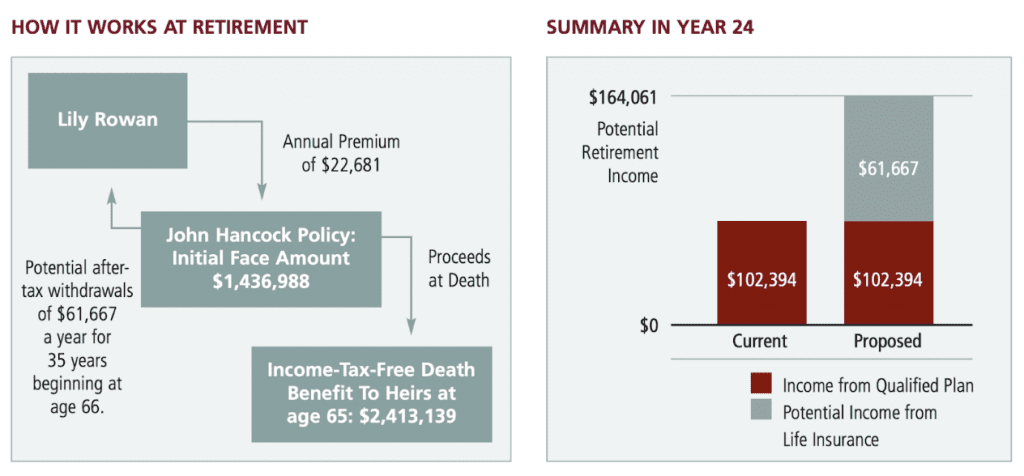
This is a hypothetical, illustrative example. It is not a real client and not a guarantee of results. Suppose Lily Rowan, age 40, is a Director of Graphic Design who recently returned to work after having her second child. She and her husband are reassessing their protection and retirement needs.Lily’s situation
- Life insurance need: approximately $1,500,000 (based on daycare costs, mortgage, and college funding goals).
- 401(k) balance: $200,000, with $22,000 contributed annually (including employer match).
- Personal savings: $40,000, with $5,500 contributed annually.
- Estimated Social Security income: $24,000 per year at retirement.
- Retirement goal: retire at 65 with approximately $100,000 per year in income, adjusted for inflation.
The strategy
Lily’s advisor identifies a projected retirement income shortfall and walks her through options to save more efficiently. Because Lily is comfortable with market-based investing (she already holds mutual funds), her advisor illustrates a variable universal life (VUL) policy, assuming a 6.64% net rate of return after taxes and fund expenses.Illustrated results
| Item | Illustrated result |
|---|---|
| Death benefit | $1,436,988 |
| Annual premium | $22,681 for 25 years (through age 65) |
| Retirement income from the policy | $61,667 per year in tax-free withdrawals and loans, starting at age 66, indexed 2% annually for inflation, through age 100 |

Benefits and Considerations of a LIRP
A LIRP offers tax-advantaged features and added protection, but it also has costs and risks you should weigh before buying.
Potential benefits
- The death benefit is generally income tax-free to beneficiaries.
- Cash value grows tax-deferred.
- Tax-free withdrawals are possible when the policy is structured properly.
- Death benefit or cash value may be protected from creditors, depending on state law.
- No IRS contribution limits like those on qualified retirement plans.
Key considerations
- Policy costs, including cost of insurance, are typically higher than fees on a Roth or traditional IRA.
- If the policy fails to meet IRS life insurance requirements, it becomes a Modified Endowment Contract (MEC), which changes how withdrawals are taxed.
- Withdrawals and loans reduce the death benefit and cash surrender value, and may cause a policy lapse.
- Variable policies carry investment risk. Cash values can be worth more or less than premiums paid.
- Additional premiums may be required to keep the policy in force, depending on performance.
Is a Life Insurance Retirement Plan Right for You?
A life insurance retirement plan is not the right fit for everyone. For families in Fort Myers and across Southwest Florida who want to combine protection with tax-advantaged retirement savings, it is worth exploring.
Schedule a consultation with our Fort Myers-based team to see how a LIRP Plus strategy could fit into your retirement plan.
Sources and Important Disclosures
- IRS: taxation of life insurance proceeds, Modified Endowment Contracts (IRC §7702A), and 401(k) rules and limits.
- SEC / FINRA: investor information on variable universal life insurance.
- Florida Department of Revenue: state income tax information.
Disclosure: This content is developed from sources believed to provide accurate information and is intended for general educational purposes. It is not tax or legal advice. Please consult a qualified tax or legal professional regarding your individual situation. Investment Advisory Services are offered through The Art and Science of Successful Planning, a Registered Investment Advisor registered in the state of Florida. Tyler G. Harrelson, CLTC®, CES®, CFS®, P.A. is a licensed insurance agent doing business as The Art and Science of Successful Planning and is independent of the Registered Investment Advisory. This communication is intended for individuals residing in Florida only.
Frequently Asked Questions
What is a life insurance retirement plan (LIRP)?
A life insurance retirement plan (LIRP) is a permanent, cash value life insurance policy structured for two purposes. It provides a death benefit to protect your family, and it builds cash value that you can access later as supplemental retirement income. In Florida, ASOFSP calls its approach LIRP Plus.
How does a life insurance retirement plan work?
You pay premiums into a permanent life insurance policy, and part of each premium builds cash value that grows tax-deferred. In retirement, you can generally access that cash value through withdrawals and policy loans. This can supplement income from sources such as a 401(k) and Social Security.
Is a LIRP better than a 401(k)?
Not necessarily. A 401(k) is typically the primary retirement savings vehicle, especially when an employer match is available. A LIRP is often used alongside a 401(k), not instead of it, to add life insurance protection and diversify how retirement income is taxed. The right mix depends on your goals and health.
What is the difference between a LIRP and an annuity?
A LIRP combines life insurance protection with savings and requires health-based underwriting. An annuity is designed mainly to provide guaranteed income and generally does not require health underwriting. If you need life insurance, a LIRP may meet both needs. If guaranteed income is your main goal, an annuity may be more appropriate.
Are LIRP withdrawals and loans really tax-free?
They can be, when the policy is structured and managed properly. Withdrawals are generally tax-free up to your basis, and policy loans are generally not taxed while the policy stays in force. If the policy becomes a Modified Endowment Contract (MEC) or lapses, the tax treatment can change.
What are the risks of a life insurance retirement plan?
Policy costs are typically higher than the fees on a Roth or traditional IRA. Withdrawals and loans reduce the death benefit and cash surrender value, and they may cause the policy to lapse. Variable policies carry investment risk, and additional premiums may be required to keep the policy in force.


