

Understanding the Business Cycle: Expansion, Peak, Contraction, Trough, and Recovery
The business cycle describes the natural rise and fall of economic activity over time. Also called the economic cycle, it reflects how an economy moves through recurring stages: growth, a high point, a slowdown, a low point, and renewed growth.
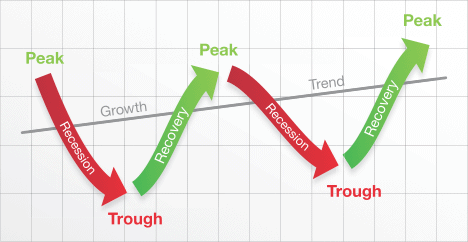
Understanding the business cycle can help you make sense of the economic news you hear — whether it’s discussion of job growth, rising prices, or a slowing stock market. While no two cycles look exactly alike, they generally move through the same four core stages: expansion, peak, contraction (recession), and trough, followed by recovery.
Economists and policymakers, including the National Bureau of Economic Research (NBER), track a range of economic indicators — such as gross domestic product (GDP), employment levels, household income, and consumer spending — to determine which stage of the cycle the economy is in.
Below is a breakdown of each stage of the business cycle and what it means.
What Is the Business Cycle?
The business cycle refers to the pattern of ups and downs in overall economic activity that occurs over months or years. It is sometimes called the economic cycle because it reflects the broader rhythm of economic growth and slowdown across the country, including here in Southwest Florida.
A few key points to understand about the business cycle:
- It is not perfectly regular — the length of each stage can vary significantly from one cycle to the next.
- It does not move in a straight line — the pattern is closer to a series of waves than a predictable, repeating loop.
- It is measured using economic indicators, including GDP growth, employment data, income levels, and consumer activity.
- Official determinations about the start and end of expansions and recessions are typically made based on data from organizations such as the NBER.
Because the business cycle affects employment, income, prices, and investment conditions, understanding its stages can help individuals and families in Fort Myers and across Southwest Florida better interpret the economic environment around them.
The Four Stages of the Business Cycle
The business cycle moves through four primary stages, each with distinct characteristics.
1. Expansion
Economic expansion is the growth phase of the business cycle. During this stage:
- Economic activity increases over a sustained period.
- Employment levels tend to rise.
- Consumer spending and business investment generally increase.
- Key economic indicators — such as GDP, income, and production — trend upward.
Expansions can last for a short period or continue for several years. There is no fixed timeline; each expansion is shaped by the specific economic conditions driving it.
2. Peak
The peak marks the high point of the business cycle. At this stage:
- Economic activity reaches its maximum level for that cycle.
- Growth in indicators like GDP and employment begins to slow or level off.
- The economy transitions from expansion toward contraction.
A peak is not always obvious while it is happening — it is often identified only in hindsight, once economic data shows that activity has begun to decline.
3. Contraction (Recession)
After the peak, the economy enters a period of contraction, commonly referred to as an economic recession. During this stage:
- Economic activity declines from its previous high point.
- Indicators such as GDP, employment, and income may fall or stagnate.
- Business investment and consumer spending often slow down.
The length and depth of a recession can vary widely:
- Some recessions are short and shallow, lasting only a few months.
- Others are longer and more severe.
- A particularly long or severe contraction is referred to as a depression.
4. Trough
The trough represents the low point of the business cycle. At this stage:
- Economic activity has declined as far as it will for that cycle.
- Indicators such as employment and output stop falling and begin to stabilize.
- The trough marks the turning point between contraction and the next stage: recovery.
Like the peak, the trough is often only recognized clearly after the fact, once data confirms that the decline has ended.
Business Cycle Recovery
Business cycle recovery is the stage that follows the trough, when economic activity begins to improve again. During recovery:
- Economic indicators — including GDP, employment, and income — start trending upward.
- Business activity and consumer confidence generally begin to strengthen.
- The economy gradually moves back toward, and eventually beyond, its previous peak, marking the start of the next expansion.
As with every stage of the business cycle, the pace of recovery is not fixed. Some recoveries build quickly, while others take longer to gain momentum before the cycle moves into its next expansion phase.
Why the Business Cycle Doesn’t Move on a Fixed Schedule
A common misconception is that the business cycle repeats on a predictable timetable. In reality:
- The economic cycle behaves more like a series of waves than a metronome.
- Expansions can last a few years or considerably longer.
- Recessions can last a few months or extend over several years.
- No two business cycles have identical timing, causes, or intensity.
This is why tracking current economic indicators — rather than assuming a fixed pattern — is the standard approach used to identify which stage of the business cycle the economy is currently experiencing.
How the Business Cycle Is Tracked
The stages of the business cycle are identified using data-driven economic indicators, which may include:
- Gross domestic product (GDP)
- Employment and unemployment rates
- Household income levels
- Consumer spending and business investment activity
Organizations such as the National Bureau of Economic Research review this data to make official determinations about when expansions, peaks, contractions, and troughs occur.
Frequently Asked Questions About the Business Cycle
What is the business cycle?
The business cycle, also called the economic cycle, is the pattern of growth and decline in overall economic activity that occurs over months or years, typically moving through expansion, peak, contraction, and trough stages.
What are the four stages of the business cycle?
The four main stages are expansion, peak, contraction (recession), and trough, followed by recovery, which leads into the next expansion.
What happens during an economic expansion?
During an economic expansion, indicators such as GDP, employment, and income generally rise as overall economic activity increases.
What is a business cycle peak?
A business cycle peak is the highest point of economic activity in a given cycle, after which growth begins to slow and the economy shifts toward contraction.
What causes an economic recession?
An economic recession occurs when economic activity contracts following a peak, often reflected in declining GDP, employment, or income levels.
What is a business cycle trough?
A business cycle trough is the lowest point of economic activity in a cycle, marking the turning point before recovery begins.
What does business cycle recovery mean?
Business cycle recovery is the stage where economic indicators begin improving after the trough, leading the economy back toward expansion.
Does the business cycle follow a fixed schedule?
No. The business cycle does not move on a regular or predictable timetable — expansions and recessions can each last anywhere from a few months to several years.
How is the business cycle measured?
The business cycle is measured using economic indicators such as GDP, employment rates, household income, and consumer activity, often reviewed by organizations like the National Bureau of Economic Research.
This content is intended for general informational purposes only and should not be considered financial, tax, or legal advice. Please consult a qualified professional regarding your individual situation.


