


What Is a Roth 401(k)? Benefits, Rules, and How It Works
Many people are familiar with traditional 401(k) plans, but fewer understand how a Roth 401(k) works or the advantages it can offer.
Since January 1, 2006, employers have been allowed to offer workers access to Roth 401(k) plans.¹ Today, many employers include a Roth 401(k) option as part of their retirement benefits.
What Is a Roth 401(k)?
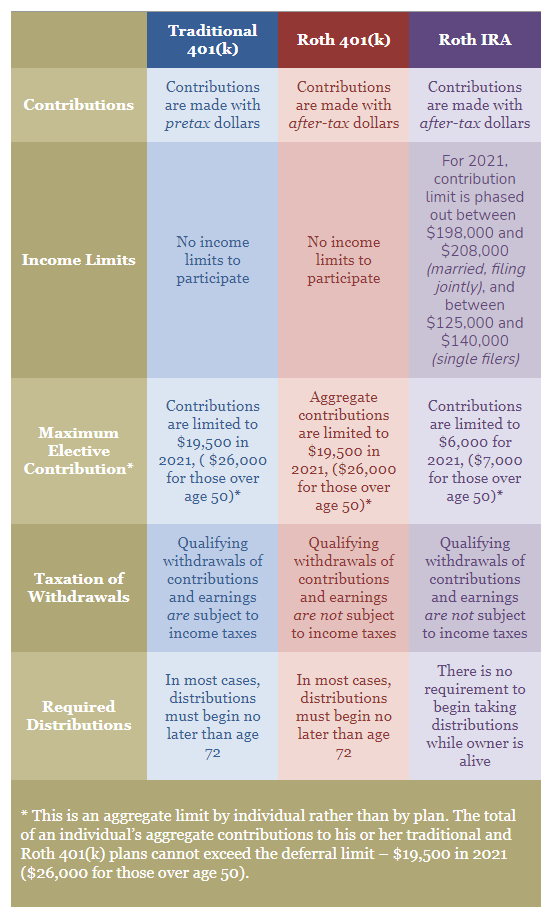
A Roth 401(k) combines features of a traditional 401(k) plan with those of a Roth IRA.²,³
How does a Roth 401(k) work? With a Roth 401(k):
- Contributions are made with after-tax dollars, so there’s no tax deduction upfront.
- Qualifying withdrawals are not subject to income tax.
- Any capital appreciation within the account is also not subject to income tax.
Roth 401(k) vs. Traditional 401(k): What to Choose?
The choice between a Roth 401(k) and a traditional 401(k) generally comes down to one question: Is the upfront tax break of a traditional 401(k) more valuable to you than the back-end benefit of tax-free withdrawals from a Roth 401(k)?
This decision isn’t always all-or-nothing. Many employers allow you to split contributions between a traditional 401(k) and a Roth 401(k), up to the overall contribution limit.
The information in this material is not intended as tax advice. It may not be used for the purpose of avoiding any federal tax penalties. Please consult a professional with tax or legal experience for specific information regarding your individual situation.
Roth 401(k) Benefits and Key Considerations
No Income Restrictions
One important Roth 401(k) advantage is that, unlike Roth IRAs, Roth 401(k) plans are not subject to income restrictions. This makes Roth 401(k)s especially useful for higher-income individuals who may be limited or ineligible for Roth IRA contributions due to income caps.
Roth 401(k) Contribution Limits
Roth 401(k) plans follow the same annual contribution limits as traditional 401(k) plans, and these are cumulative across account types with a single employer. For example, you cannot contribute the full limit to a traditional 401(k) and then contribute the full limit again to a Roth 401(k) with the same employer; the limit applies to your combined contributions.⁴
For 2026, IRS contribution limits are:
- $24,500 standard employee contribution limit
- $32,500 total limit for employees age 50 and older (including catch-up contributions)
- $11,250 enhanced catch-up limit for employees ages 60–63, in place of the standard catch-up amount
Employer Matching Funds
Employer matching contributions are made with pretax dollars, just as they are in a traditional 401(k) plan. In a Roth 401(k), however, these matching funds accumulate in a separate account and are taxed as ordinary income when withdrawn.
Roth 401(k) Tax Benefits Summary
| Traditional 401(k) | Roth 401(k) | |
|---|---|---|
| Contributions | Pretax (tax deduction now) | After-tax (no deduction now) |
| Qualifying withdrawals | Taxed as ordinary income | Not subject to income tax |
| Capital appreciation | Taxed at withdrawal | Not subject to income tax |
| Income restrictions | None | None |
Source: IRS.gov
Is a Roth 401(k) Right for You?
Setting money aside for retirement is part of a sound personal financial strategy. Deciding between a traditional 401(k) and a Roth 401(k) involves reviewing several factors specific to your income, tax situation, and retirement goals.
If you’re a Fort Myers or Southwest Florida resident who is uncertain which option best fits your situation, working with a qualified tax or financial professional can help you weigh the trade-offs and make an informed decision.
Frequently Asked Questions
What is a Roth 401(k)?
A Roth 401(k) is an employer-sponsored retirement plan that combines features of a traditional 401(k) with those of a Roth IRA. Contributions are made after-tax, and qualifying withdrawals, including any investment growth, are not subject to income tax.
How does a Roth 401(k) work?
With a Roth 401(k), you contribute after-tax dollars from your paycheck. Because taxes are already paid on contributions, qualifying withdrawals in retirement, including earnings, are withdrawn tax-free.
What are the benefits of a Roth 401(k)?
Key Roth 401(k) benefits include tax-free qualifying withdrawals, tax-free growth on investments, and no income restrictions on eligibility, unlike Roth IRAs, which phase out at higher income levels.
What is the difference between a Roth 401(k) and a traditional 401(k)?
A traditional 401(k) is funded with pretax dollars and gives you a tax deduction now, but withdrawals are taxed as ordinary income in retirement. A Roth 401(k) is funded with after-tax dollars, so there’s no upfront deduction, but qualifying withdrawals are tax-free.
What are the Roth 401(k) contribution limits?
For 2026, the standard contribution limit is $24,500. Employees age 50 and older can contribute up to $32,500 total, and those ages 60–63 may be eligible for an enhanced catch-up limit of $11,250 in place of the standard catch-up amount.
Are there income limits for a Roth 401(k)?
No. Unlike Roth IRAs, Roth 401(k) plans do not have income restrictions, so high earners who may be ineligible for a Roth IRA can still contribute to a Roth 401(k).
1. To qualify for the tax-free and penalty-free withdrawal of earnings, Roth 401(k) distributions must meet a five-year holding requirement and occur after age 59½. Tax-free and penalty-free withdrawals also can be taken under certain other circumstances, such as the owner’s death or disability. Employer matches are pretax and are not distributed tax-free during retirement. Under SECURE 2.0, required minimum distributions generally must begin at age 73.
2. Required minimum distributions from your 401(k) or other defined contribution plan generally must begin at age 73 under SECURE 2.0. Withdrawals from your 401(k) or other defined contribution plans are taxed as ordinary income, and if taken before age 59½, may be subject to a 10% federal income tax penalty.
3. Roth IRA contributions cannot be made by taxpayers with high incomes. For 2026, the income phaseout range is $153,000–$168,000 for single filers and $242,000–$252,000 for those married filing jointly. To qualify for the tax-free and penalty-free withdrawal of earnings, Roth IRA distributions must meet a five-year holding requirement and occur after age 59½. Tax-free and penalty-free withdrawals also can be taken under certain other circumstances, such as the owner’s death or disability. The original Roth IRA owner is not required to take minimum annual withdrawals.
4. IRS.gov
The content is developed from sources believed to be providing accurate information. The information in this material is not intended as tax or legal advice. It may not be used for the purpose of avoiding any federal tax penalties. Please consult a legal or tax professional for specific information regarding your individual situation. The opinions expressed and material provided are for general information and should not be considered a solicitation for the purchase or sale of any security.


