

Sources of Retirement Income: Where Will Your Money Come From?
Understanding the Main Sources of Retirement Income
For most people, retirement income doesn’t come from a single place—it’s built from a combination of sources. Understanding the main sources of retirement income can help Fort Myers and Southwest Florida retirees plan more confidently for the years ahead.
Here’s a review of the six primary retirement income sources.
1. Social Security
Social Security is the government-administered retirement income program. Workers become eligible after paying Social Security taxes for at least 10 years.
Key details about how benefits are calculated:
- Benefits are based on your 35 highest-earning years
- If you have fewer than 35 years of earnings, the missing years are averaged in as zero¹
- The average monthly Social Security benefit was estimated at $1,543 in 2021²
2. Personal Savings and Investments
Retirement income from personal savings includes any savings and investments held outside of formal retirement plans. Many retirees prioritize investments offering monthly guaranteed income over those focused purely on potential growth, since predictable income becomes more valuable in retirement.
3. Individual Retirement Accounts (IRAs)
Traditional IRAs
Traditional IRAs have existed since 1974. Key features include:
- Contributions may be fully or partially tax-deductible, depending on your circumstances
- Under the SECURE Act, most individuals must begin taking required minimum distributions (RMDs) starting at age 72
- Withdrawals are taxed as ordinary income
- Withdrawals taken before age 59½ may incur a 10% federal tax penalty
- You may continue contributing past age 70½ under the SECURE Act, as long as you meet the earned-income requirement
Roth IRAs
Roth IRAs were introduced in 1997 and work differently:
- High-income taxpayers may not be eligible to contribute
- To withdraw earnings tax-free and penalty-free, you must meet a five-year holding requirement and be at least age 59½
- Tax-free and penalty-free withdrawals may also apply under certain other circumstances, such as the owner’s death
- The original Roth IRA owner is not required to take minimum annual withdrawals
4. Defined Contribution Plans (401(k), 403(b), 457)
Many workers have access to a defined contribution plan, such as a 401(k), 403(b), or 457 plan. These plans allow eligible workers to set aside pre-tax income, which accumulates on a tax-deferred basis.
Important rules to know for 401(k) retirement income:
- Under the SECURE Act, RMDs generally must begin in the year you turn 72
- Withdrawals are taxed as ordinary income
- Withdrawals before age 59½ may be subject to a 10% federal tax penalty
5. Defined Benefit Plans (Pensions)
Pension income in retirement comes from defined benefit plans—traditional, employer-sponsored plans where the benefit amount, rather than the contribution amount, is predetermined.
Pension benefits are typically based on:
- Salary history
- Duration of employment
It’s worth noting that the number of traditional pension plans has declined significantly over the past 30 years.³
6. Continued Employment
Working during retirement is increasingly common in expectation, though not always in practice:
- 71% of current workers say they plan to keep working in retirement
- Only 31% of actual retirees report continued employment as a major or minor source of retirement income⁴
Expected vs. Actual Sources of Retirement Income
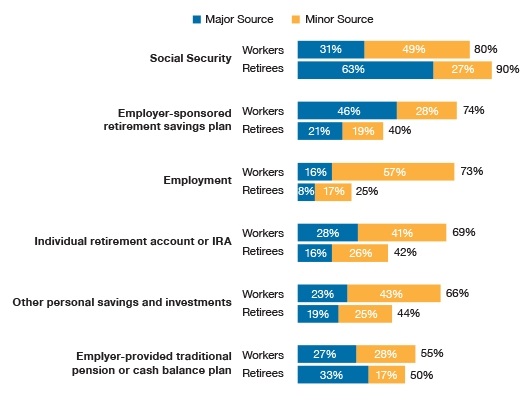
There’s often a notable gap between what workers expect their retirement income sources to be and what retirees actually experience once they retire. This is one reason retirement income planning well before your retirement date matters—assumptions made early on don’t always hold up in practice.
If you’re a Fort Myers-area resident working through retirement income planning and want to understand how Social Security, personal savings, IRAs, 401(k) plans, pensions, and continued employment might fit together for your specific situation, ASOFSP can help you build a coordinated plan.
Frequently Asked Questions
What are the main sources of retirement income?
The six main sources are Social Security, personal savings and investments, Individual Retirement Accounts (IRAs), defined contribution plans like 401(k)s, defined benefit pension plans, and continued employment.
How is Social Security retirement income calculated?
Social Security benefits are based on your 35 highest-earning years. If you have fewer than 35 years of earnings, the remaining years are averaged in as zero.
What’s the difference between a Traditional IRA and a Roth IRA for retirement income?
Traditional IRA withdrawals are taxed as ordinary income and require minimum distributions starting at age 72. Roth IRA withdrawals can be tax-free and penalty-free if you meet the five-year holding rule and are at least 59½, and the original owner isn’t required to take minimum distributions.
When do I have to start taking withdrawals from my 401(k)?
Under the SECURE Act, most individuals must begin taking required minimum distributions from a 401(k) or other defined contribution plan in the year they turn 72.
Is pension income still common in retirement?
Traditional pension plans (defined benefit plans) have become less common over the past 30 years, though some workers still receive pension income based on salary history and years of employment.
Do most retirees actually work during retirement?
Not as many as expected. While 71% of workers say they plan to work in retirement, only 31% of actual retirees report continued employment as a source of income.
Why is there a gap between expected and actual retirement income sources?
Financial circumstances, health, and job availability can all change unexpectedly, which is why what workers plan for often differs from what they actually experience in retirement.
How can Fort Myers retirees plan for multiple sources of retirement income?
ASOFSP helps Southwest Florida clients coordinate Social Security, savings, IRAs, 401(k) plans, and other income sources into a comprehensive retirement income plan.


