

What Will Matter Most in the 2026 Midterms?
From competitive races to voter dynamics, a look at the factors that could shape what comes next in Washington.
Election Day is Tuesday, November 3, and control of Congress is up for grabs. The results will influence both the administration’s agenda and lawmakers’ legislative priorities over the next two years, yet exactly how the balance of power will land is still unsettled.
Below is a look at what analysts are watching: the House map, the Senate battlegrounds, the role of independent voters, and what a change in control could and could not mean.
- Democrats have more opportunities to gain ground in both chambers, but the path to control isn’t straightforward. The map, the candidates, and turnout could all shape how far any gains extend.
- Recent midterms show the president’s party can lose significant House ground, though the size of those losses has varied considerably.
- Independent voters may matter, but where they lean is only part of the equation. Low motivation could limit their impact.
- A change in control could shift priorities and oversight, but divided government may also limit what lawmakers can accomplish.
Where the race stands
Recent developments have generally moved in Democrats’ favor. They have gained ground in a number of House and Senate races, including some in traditionally Republican territory. This comes against a difficult national backdrop for Republicans: a Reuters/Ipsos poll in October put President Trump’s approval at a record low of 31%, and Democrats have held an advantage in generic congressional ballot polling.
National trends only tell part of the story, though. Individual races, local dynamics, and turnout will determine whether those gains translate into a change in control.
A broader path to a House majority doesn’t guarantee a Democratic wave.
A competitive House map puts control in play
Democrats need a net gain of just three seats to take the House, and their opportunities have been expanding. Recent race ratings show Republicans defending competitive districts and open seats in traditionally Republican territory. Several districts that backed Trump by double digits in 2024 have become more competitive, and a growing number of Republican-held open seats lack the advantage of an incumbent.
That widens the Democratic path, but Republicans still benefit from the current congressional map, and candidate quality, local dynamics, and turnout could determine how far the pendulum swings.
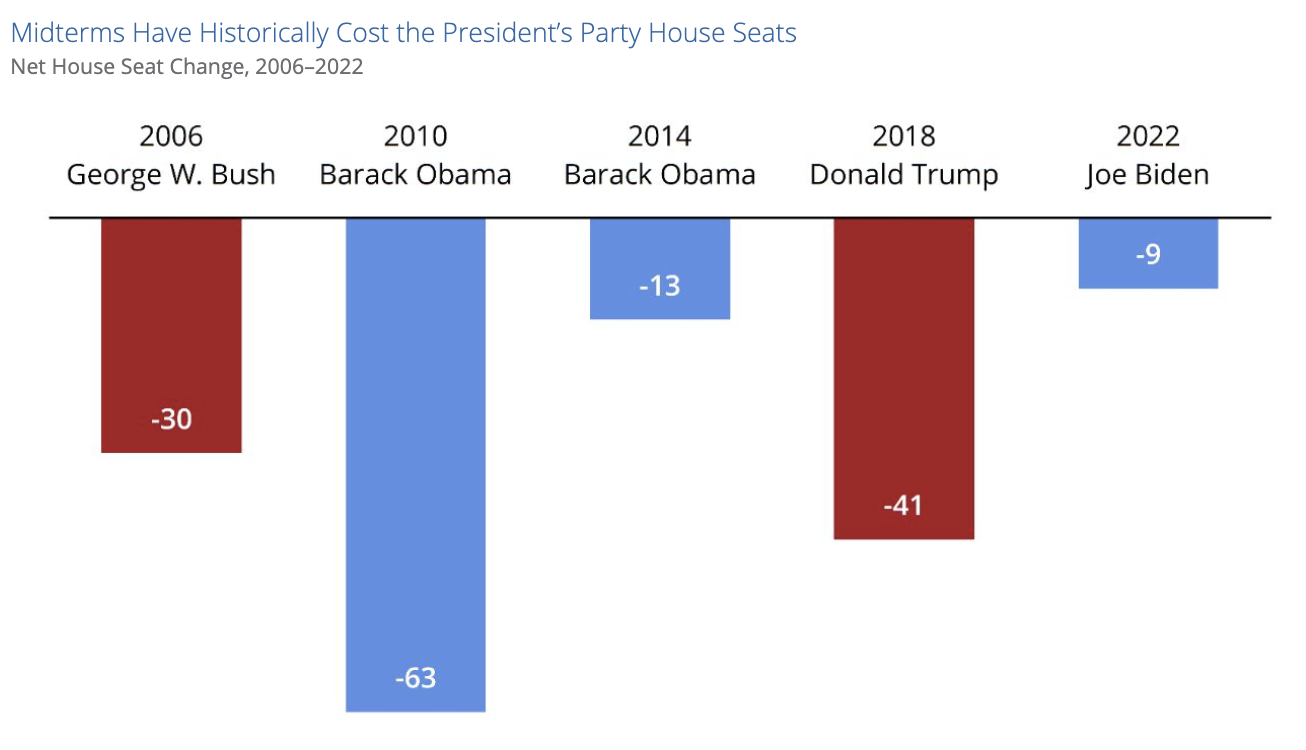
There is plenty of precedent for large midterm losses. Republicans lost 41 House seats in 2018 under President Trump, and Democrats lost 63 during President Obama’s first midterm in 2010. The comparison only goes so far, however. Increased polarization and redistricting have made today’s map less prone to dramatic swings, which could put a ceiling on gains even in a favorable national environment.
Midterms have historically cost the president’s party House seats
Several states could tip the balance in the Senate
The Senate fight has also tightened. Republicans hold a 53–47 majority, so Democrats need a net gain of four seats for control. With competitive races across an unusually broad map, the chamber is firmly in play. As of October 23, race ratings from the Cook Political Report showed the following:
A competitive map keeps Senate control uncertain
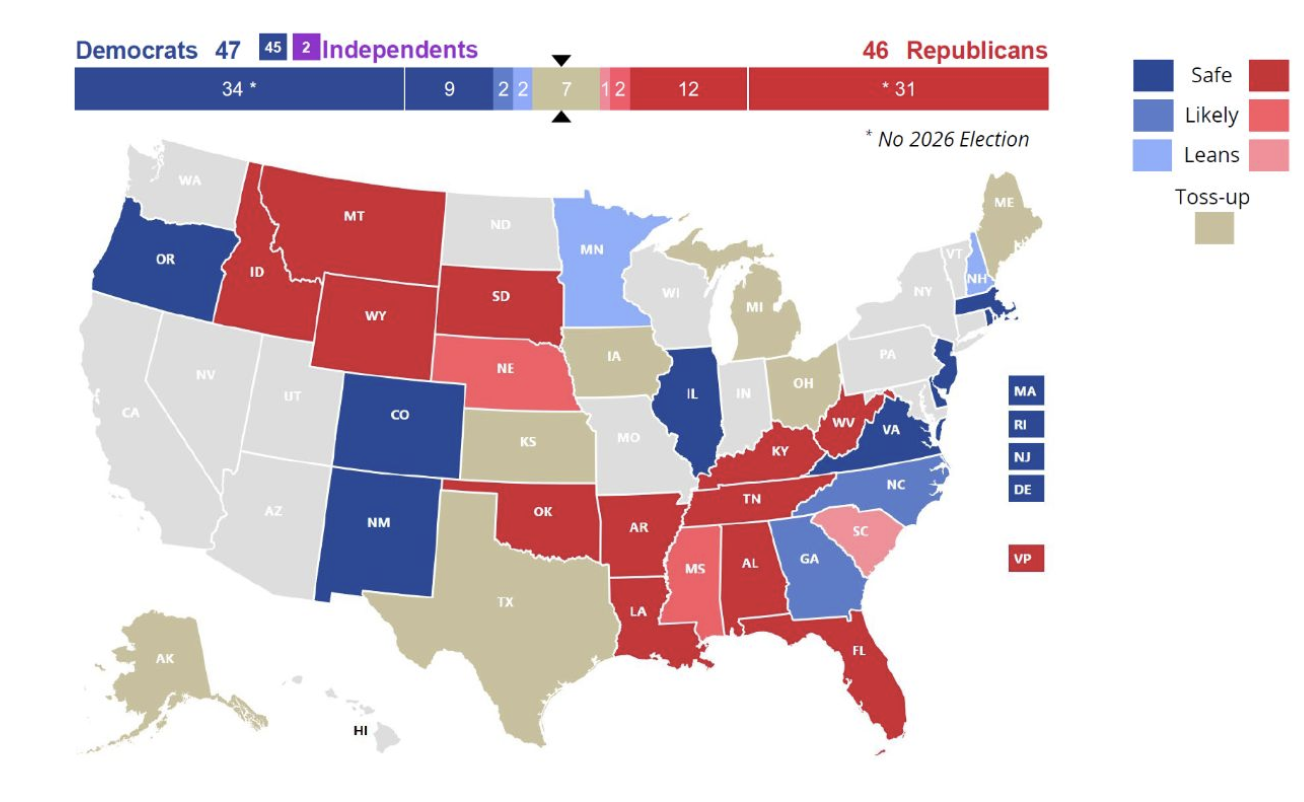
- TexasNeck and neckOne of the cycle’s most closely watched races, with Democrat James Talarico and Republican Ken Paxton essentially tied.
- Alaska, Maine, OhioTightly contestedEach offers Democrats a potential pickup opportunity.
- Kansas, IowaIncreasingly competitiveRaces that would normally draw less attention are forcing Republicans to defend more territory.
- New HampshireShiftingHas moved toward Democrats.
- MississippiLate attentionHas drawn additional Republican attention late in the race.
Taken together, these developments suggest neither party can afford to focus only on the traditional battlegrounds. Democrats still have work to do to reach the four seats they need, and Republicans have a clear path to retaining control, but with more races in play the contest has expanded well beyond where it began.
For independent voters, turnout may be the bigger question
Independent and unaffiliated voters are another group to watch, particularly given the growing share of Americans who don’t identify with either major party. Their margin has varied widely: independents favored Democrats by 12 points in 2018, when Democrats gained 41 House seats, compared with just two points in 2022. With a sizable share still undecided, their impact this year is hard to predict.
The larger question may be whether they vote at all. In a Change Research poll conducted in July, 58% of pure independents rated their motivation to vote at eight or higher on a 10-point scale, compared with 89% of Democrats and 82% of Republicans. Twelve percent of independents rated their motivation at zero, versus 2% of Democrats and 3% of Republicans. That gap could matter as much as which party independents favor.
What changes after the midterms, and what doesn’t
Whatever the outcome, the results will help shape the legislative and regulatory environment heading into 2027. A shift in congressional control could redirect federal spending, regulatory oversight, and the legislative agenda, and new committee leadership could reshape negotiations on taxes, healthcare, financial regulation, and emerging technologies.
Divided government, on the other hand, could make sweeping legislation harder to pass, leaving executive action, agency rulemaking, and state policy to play a larger role. The election could also bring in a sizable class of new lawmakers with new priorities, potentially shifting dynamics within both parties.
The election itself marks a shift rather than an endpoint. Trade disputes, geopolitical conflicts, and other policy challenges will continue to shape the landscape regardless of who controls Congress.
Sources: Adapted from “What Will Matter Most in the 2026 Midterms?” by JT Taylor, Chief Political Strategist and Macro Policy Sector Head, Hedgeye Potomac Research, published by Hartford Funds, October 2026. Underlying data: Reuters/Ipsos poll (10/20/26); Cook Political Report via 270toWin (as of 10/23/26); The American Presidency Project; FiftyPlusOne and Change Research (poll conducted July 13–17, 2026). The views expressed are those of the original author and are not those of The Art and Science of Successful Planning.
This article is for general educational purposes only. It is not tax, legal, or investment advice, a forecast, or a recommendation regarding any particular security or strategy, and it does not reflect support for any candidate or party. Investing involves risk, including the possible loss of principal. Please consult a qualified professional about your individual situation.
Investment Advisory Services offered through The Art and Science of Successful Planning, a Registered Investment Advisor registered in the state of FL. Content is current as of the publication date and may be superseded by subsequent market and economic conditions.


