War and geopolitical shocks almost always trigger short-term stock market volatility — but history shows the impact rarely lasts. Since World War II, the S&P 500 has posted positive returns one year after the start of a major conflict in 73% of cases, and that figure climbs to 95%–100% over 5- and 10-year horizons. For long-term investors, staying invested through geopolitical uncertainty has historically paid off.
How War Affects the Stock Market in the Short Term
Military conflicts and geopolitical instability create genuine uncertainty, and markets react to uncertainty by repricing risk quickly. That’s why stock market volatility during war is common in the days and weeks after a conflict begins — investors sell first and assess later.
But “volatile” doesn’t mean “permanently damaged.” Historical data on stock market performance during war consistently shows that:
- Initial reactions vary widely — some conflicts triggered sharp drops, others barely moved markets, and a few sparked rallies
- Short-term losses have frequently reversed within a year
- The longer the holding period, the more likely returns turn positive
Stock Market Performance During Major Conflicts (1940–2026)
The table below tracks S&P 500 price returns following major geopolitical and military events, from World War II through the most recent US and Israel strikes on Iran in February 2026.
| Geopolitical/Military Event (Start Date) | 3 Months Later | 1 Year Later | 3 Years Later (Ann.) | 5 Years Later (Ann.) | 10 Years Later (Ann.) |
|---|---|---|---|---|---|
| Germany Invades France (May 1940) | -15.3% | -22.0% | -0.9% | 4.1% | 4.2% |
| Pearl Harbor Attack (Dec 1941) | -12.4% | 0.4% | 11.7% | 9.5% | 9.6% |
| Korean War (Jun 1950) | 1.5% | 11.2% | 8.1% | 16.4% | 11.7% |
| Cuban Missile Crisis (Oct 1962) | 17.4% | 32.0% | 18.3% | 11.4% | 7.0% |
| US Bombs Cambodia (Apr 1970) | -4.6% | 27.1% | 9.4% | 0.9% | 2.6% |
| Arab Oil Embargo (Oct 1973) | -13.2% | -36.2% | -2.9% | -1.4% | 4.4% |
| Iranian Hostage Crisis (Nov 1979) | 11.6% | 25.9% | 11.4% | 10.3% | 12.7% |
| USSR Invades Afghanistan (Dec 1979) | -8.8% | 26.2% | 9.1% | 9.0% | 12.4% |
| Beirut Bombing (Oct 1983) | -0.7% | 0.7% | 13.0% | 11.3% | 10.8% |
| US Invades Grenada (Nov 1983) | -1.1% | 0.7% | 12.8% | 11.2% | 10.8% |
| US Bombs Libya (Apr 1986) | -0.5% | 19.9% | 8.3% | 9.9% | 10.5% |
| Invasion of Panama (Dec 1989) | -2.9% | -6.9% | 7.5% | 5.6% | 15.0% |
| Iraq Invades Kuwait (Aug 1990) | -10.5% | 10.2% | 8.6% | 9.7% | 15.1% |
| Operation Desert Storm (Jan 1991) | 21.5% | 32.3% | 14.5% | 14.0% | 15.4% |
| Gorbachev Coup (Aug 1991) | -1.8% | 9.3% | 6.3% | 11.5% | 11.9% |
| World Trade Center Bombing (Feb 1993) | 1.5% | 5.4% | 13.7% | 18.7% | 6.5% |
| 9/11 Terrorist Attacks (Sep 2001) | 2.5% | -16.7% | 0.9% | 3.5% | 0.6% |
| Iraq War (Mar 2003) | 15.6% | 27.0% | 14.3% | 8.2% | 5.9% |
| Russia Invades Georgia (Aug 2008) | -34.3% | -22.3% | -4.7% | 5.5% | 8.1% |
| Russia Invades Crimea (Mar 2014) | 3.9% | 10.7% | 8.0% | 7.9% | 10.6% |
| Russia Invades Ukraine (Feb 2022) | -13.0% | -11.0% | 9.5% | — | — |
| Hamas Attacks Israel (Oct 2023) | 9.7% | 33.6% | — | — | — |
| Israel Attacks Iran’s Nuclear Facilities (Jun 2025) | 8.9% | — | — | — | — |
| US and Israel Attack Iran (Feb 2026) | ??? | — | — | — | — |
| Median | -0.7% | 9.7% | 9.1% | 9.6% | 10.5% |
| % Positive | 43% | 73% | 86% | 95% | 100% |
Past performance does not guarantee future results. Indices are unmanaged and not available for direct investment. Data shown does not include the reinvestment of dividend payments. Data Sources: Morningstar, Ned Davis Research, and Hartford Funds, 3/26.
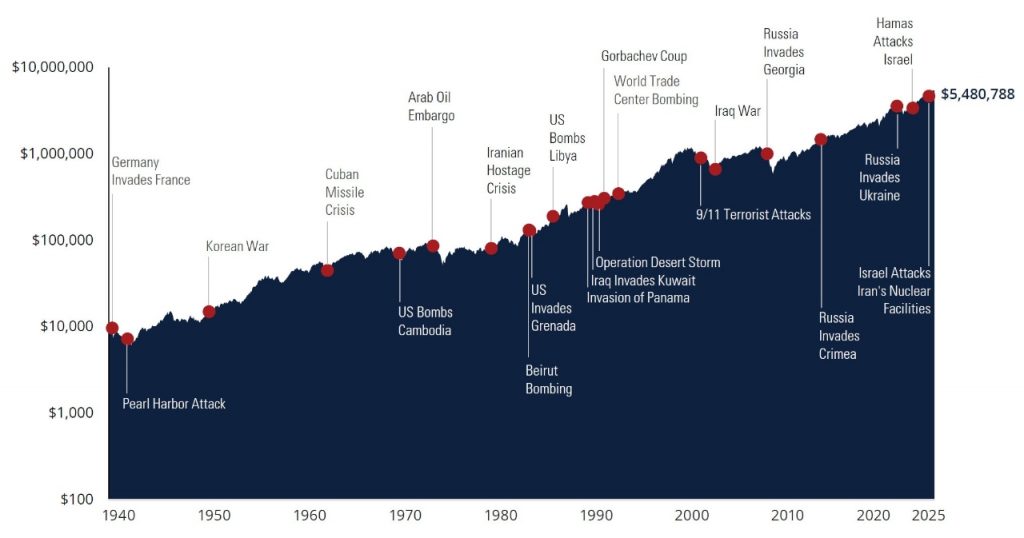
Growth of $10,000 in the S&P 500 Price Index (1940–2025)
Despite dozens of wars, invasions, and geopolitical crises over the last 85+ years, a hypothetical $10,000 invested in the S&P 500 Price Index in 1940 would have grown substantially by 2025 — underscoring that geopolitical conflicts have had minimal impact on long-term equity performance.
market stats
What This Means for Investors Facing Geopolitical Risk
The data points to a consistent pattern: stock market volatility during war tends to be a short-term phenomenon, not a long-term trend.
- At the 3-month mark, only 43% of conflicts saw positive returns — the immediate aftermath is genuinely unpredictable
- By 1 year, that rises to 73%
- By 3 years, 86%
- By 5 years, 95%
- By 10 years, 100%
For investors managing portfolios through periods of geopolitical uncertainty, this history suggests that reacting emotionally to headlines — by selling in a panic — has historically been costlier than staying the course.
Investing During Geopolitical Uncertainty: A Few Principles to Keep in Mind
- Expect short-term noise. Markets often move sharply in the first days or weeks of a conflict, in either direction.
- Focus on your time horizon. The data shows the probability of positive returns increases the longer you stay invested.
- Avoid trying to time the market. No two conflicts unfold the same way, and reacting to one historical pattern doesn’t guarantee the next outcome will match it.
- Review your risk tolerance, not just the headlines. Geopolitical events are a good prompt to revisit your overall financial plan — not necessarily to make reactive changes.
Whether you’re an investor here in Florida or anywhere else, working with a financial professional who understands how geopolitical risk interacts with your specific goals and time horizon can help you avoid emotionally driven decisions during periods of conflict or uncertainty.
FAQ: Stock Market and War
Does war always cause the stock market to drop?
No. While many conflicts triggered short-term declines, some — like Operation Desert Storm and the Cuban Missile Crisis — were followed by strong market gains within three months. Reactions vary by event.
How long does stock market volatility during war typically last?
Historically, the most pronounced volatility has occurred in the first three months after a conflict begins. Returns have tended to stabilize and turn positive more consistently by the one-year mark and beyond.
Should I sell stocks during a war or geopolitical crisis?
This depends on individual circumstances, but historical data shows that investors who remained invested through past conflicts were rewarded more often than not, especially over longer time horizons. A financial advisor can help evaluate what makes sense for your specific situation.
What happens to the stock market after a war ends?
Post-conflict performance in the data above shows a strong pattern of recovery and growth over 3-, 5-, and 10-year periods following the start of major conflicts, with 95%–100% of historical cases showing positive returns at the 5- and 10-year marks.
Is investing during geopolitical uncertainty risky?
All investing carries risk, and geopolitical events can add short-term uncertainty. However, historical data suggests that broad market impacts from individual conflicts have generally been temporary rather than permanent.
Talk to a Financial Advisor About Your Portfolio
Geopolitical headlines can be unsettling, but decisions about your portfolio should be based on your personal goals, time horizon, and risk tolerance — not short-term news cycles. If you’re an investor in Florida looking for guidance on navigating market uncertainty, reach out to discuss a strategy built around your long-term plan.