

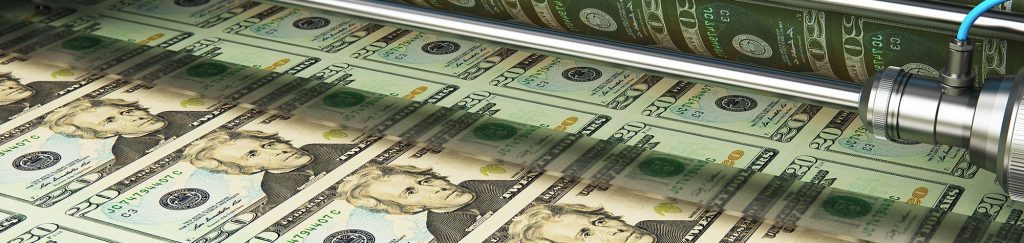
How a $20 Bill Is Made: Life and Death of a Twenty Dollar Bill
Every year, the government prints millions of notes a day. Here’s a closer look at how a $20 bill is made — from raw paper to finished currency — and what eventually determines when a bill’s lifespan ends.
What Is $20 Bill Paper Made Of?
A $20 bill starts as part of a large sheet of paper. But unlike most paper, which is made primarily from wood pulp, the paper used by the U.S. Bureau of Engraving and Printing (BEP) doesn’t contain any wood at all.
Currency paper is made from:
- A special blend of 75% cotton and 25% linen
- Distinctive watermarks
- Embedded blue and red fibers
- A special security thread
Each blank sheet is tracked from the moment it leaves the mill until it’s printed, and every shipment is continuously reconciled to ensure all sheets are accounted for.
The $20 Bill Printing Process
Understanding how money is printed starts with the presses. Blank sheets of cotton-linen paper are printed four separate times:
- Background printing — Background images and colors are printed on both sides at once, using offset presses that are over 50 feet long and weigh more than 70 tons.
- Back printing — After drying for 72 hours, portraits, vignettes, scrollwork, numerals, and letters are printed on the back using Intaglio presses (about 40 feet long, weighing roughly 50 tons).
- Front printing — After another 72-hour drying period in specially guarded cages, more portraits, vignettes, scrollwork, numerals, and letters are printed on the front using the same Intaglio presses.
- Final details — Serial numbers, the Federal Reserve seal, the Treasury Department seal, and Federal Reserve identification numbers are added using a letterpress.
Cutting and Wrapping Newly Printed Bills
Once the printed sheets are fully dry, they go through a final production stage:
- Sheets are gathered in stacks of 100 and cut using a specially designed guillotine cutter
- Each stack of 100 $20 bills is wrapped in a special paper band
- Ten of these 100-note stacks are machine-counted and shrink-wrapped into a bundle
- Four shrink-wrapped bundles are collated, labeled with a barcode, and shrink-wrapped again into a “brick” of 4,000 bills — worth $80,000
How Newly Printed $20 Bills Reach Circulation
The Treasury Department ships newly printed $20 bills to Federal Reserve Banks, which distribute them to banks and savings institutions — primarily in exchange for old, worn-out bills. From there, the new bills reach customers through bank tellers and ATMs.
An average $20 bill changes hands often, but even the BEP can’t say exactly how many times a bill moves from pocket to pocket. Contrary to popular belief, the government has no way to track individual bills.
What Is the Security Thread on a $20 Bill?
Each $20 bill contains a polyester security thread embedded vertically in the paper. Looking closely, you can see the initials “USA TWENTY,” the bill’s denomination, and a small flag along the thread — visible from both sides of the bill. This thread makes currency harder to counterfeit, but it cannot be tracked electronically.
What Happens to Worn-Out $20 Bills?
When a $20 bill reaches the end of its life, here’s what happens:
- Banks collect worn and damaged currency and send it to the Federal Reserve in exchange for new bills
- The Federal Reserve sorts through returned bills to determine which are still usable
- Usable bills are stored for recirculation through the commercial banking system
- Bills no longer usable are shredded into confetti-like pieces
- Most shredded currency is disposed of; a small portion is sold in five-pound bags through the Treasury’s website
Frequently Asked Questions
How is U.S. currency made?
U.S. currency is made from a special blend of 75% cotton and 25% linen paper — not wood-pulp paper — and is printed in four separate stages using offset, Intaglio, and letterpress printing methods, followed by cutting and wrapping.
How is a $20 bill printed?
A $20 bill is printed four times: background colors on both sides, portraits and detail work on the back, matching detail work on the front, and finally serial numbers and official seals using a letterpress.
What is a $20 bill made of?
A $20 bill is made from currency paper composed of 75% cotton and 25% linen, along with watermarks, embedded blue and red fibers, and a security thread.
How much is a “brick” of $20 bills worth?
A brick of $20 bills contains 4,000 notes and is worth $80,000.
Can the government track individual dollar bills?
No. While each $20 bill has a security thread designed to deter counterfeiting, the government has no way to electronically track individual bills as they change hands.
What happens to worn-out $20 bills?
Worn and damaged bills are returned to the Federal Reserve through banks, sorted for usability, and shredded if no longer fit for circulation. Most shredded currency is disposed of, though a small amount is sold to the public in bags through the Treasury’s website.
The content is developed from sources believed to be providing accurate information. The information in this material is not intended as tax or legal advice and may not be used for the purpose of avoiding any federal tax penalties. Please consult a legal or tax professional for specific information regarding your individual situation. The opinions expressed and material provided are for general information only and should not be considered a solicitation for the purchase or sale of any security.


