


There’s no arguing that 2022 wasn’t a brutal year for the bond markets and bonds. Virtually every segment suffered material declines, with investors’ risk aversion sending spread sectors lower while rising interest rates pushed rate-sensitive securities into the red.
In the end, the Bloomberg U.S. Aggregate Bond Index lost just over 13%, only its sixth calendar-year loss in the index’s history and the worst year for bonds since the Great Depression.1 With the damage done, though, two important questions remain for investors: What exactly caused such an outlier of a collapse and, even more vitally, how should investors respond?
The pace of rate increases has been unusually aggressive
The U.S. Federal Reserve’s (Fed’s) dual mandate—full employment and price stability—doesn’t always require equal attention. The post-pandemic labor market remains exceptionally strong, with unemployment recently hitting a 53-year low. Inflation, however, has been a persistent challenge.
The Current Tightening Cycle
The Fed began its current tightening cycle in March 2022. At that time, inflation was already above 8% year over year and had risen in 10 of the previous 12 months since crossing the 2% threshold in March 2021. Hindsight suggests the Fed started raising rates later than ideal. The pace of hikes reflects this; even in 1994, rate increases weren’t this severe.
The Fed’s current tightening cycle has sent rates higher, faster
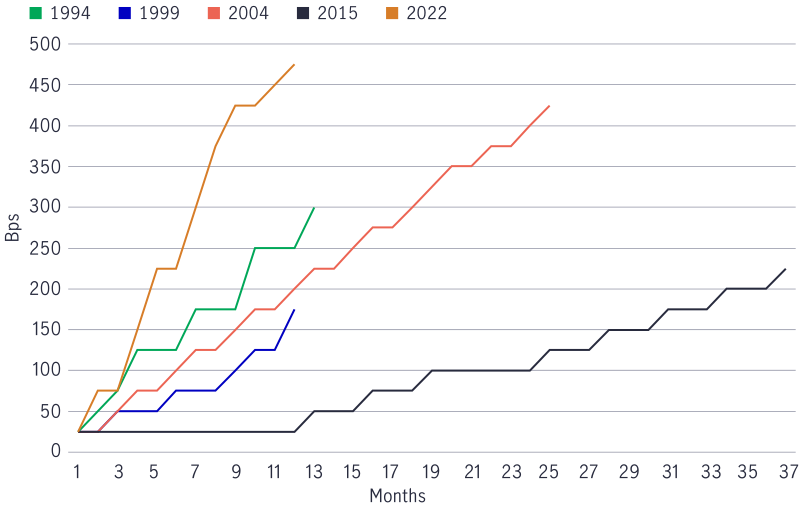
Source: Federal Reserve Bank of St. Louis, as of March 31, 2023. One hundred basis points (bps) equals one percent.
Impact on Investors
The rapid tightening caused significant pain for investors in 2022. Income from bonds wasn’t enough to offset the sharp price declines. When the Fed began tightening, yields were extremely low—the 10-year U.S. Treasury offered just over 2%—making losses almost unavoidable.
What’s Next?
With 475 basis points of rate hikes already implemented, the Fed may be at or near the end of this tightening cycle. March inflation data showed a 5% increase, continuing a downward trend since June 2022. Other factors, such as tighter lending standards in some banking sectors, may also help reduce inflation. Even if the Fed has one or two more hikes, the current cycle suggests that avoiding duration risk entirely may not provide much benefit.
Short duration bonds are unlikely to repeat last year’s performance
Although short duration bonds recorded losses in 2022, they were among the best-performing fixed-income segments last year.1 This is unsurprising given the combination of investors dialing down risk and interest rates rising across the board. However, we believe short duration’s relative outperformance is unlikely to last.
Looking at the past four tightening cycles, the Fed paused for 7 to 15 months between its final hike and the next rate cut. While it’s possible this cycle will differ, it’s extremely rare for the Fed to pivot immediately from tightening to easing.
Intermediate Bonds Historically Outperform
During plateaus when rates remain stable, intermediate-term bonds tend to outperform short duration bonds. When rates eventually fall, this pattern usually continues: longer duration helps investors capture gains. History suggests that the risk-dampening benefits of short duration bonds are therefore relatively short-lived.
Reinvestment Risk for Short Duration Investors
A less obvious risk for short duration investors is reinvestment risk. If the U.S. economy enters a recession and the Fed cuts rates, investors will need to reinvest maturing securities at lower yields. This can be unattractive, especially in a rapidly moving market.
For example, the 2-year U.S. Treasury traded at 5.05% on March 8. By March 23, the day after the Fed’s meeting, it had fallen to 3.76%. That’s a significant swing in just over two weeks. An earlier-than-expected rate cut could create additional headaches for investors reinvesting principal from short-dated securities.
Key Takeaway
Less duration does not necessarily mean less risk in this environment. Short duration may reduce interest rate exposure temporarily, but reinvestment risk and historical trends suggest that longer-term bonds often outperform over the full cycle.
Starting yields have always been a significant driver of total returns
While we’re unapologetic believers in the value of active management, there are certain maxims that are true of the market in general. One of them is that, all else being equal, higher starting yields are correlated with higher forward total returns. That’s good news for investors with any dry powder to deploy: Yields today in the high-yield space are on par with the distressed levels they hit in 2020, while the investment-grade segment is offering yields not seen since 2008.1 We believe these levels represent extremely attractive entry points given the health of the underlying economy. While it’s entirely possible the economy slides into a recession in the next 12 months, slowing growth has historically only served as a further tailwind to high-quality bonds as investors rotate out of riskier assets.
While in the end, 2022 was undeniably a historically tough year for bonds, one can’t move forward while looking in the rear-view mirror—and that’s certainly true of investing. That said, we believe it’s unlikely that 2023 brings just more of the same. With substantially higher yields and a reasonably solid economic backdrop, intermediate-term bonds in the core and core-plus spaces look more attractive now than they have in years—especially relative to the low duration or higher-risk options in the market.
Reposted from John Hancock Investment Management
Index definitions: The Bloomberg 1–3 Year U.S. Aggregate Bond Index tracks publicly issued medium and larger issues of U.S. government, investment-grade corporate, and investment-grade international U.S. dollar-denominated bonds that have maturities of between one and three years. The Bloomberg U.S. Aggregate Bond Index tracks the performance of U.S. investment-grade bonds in government, asset-backed, and corporate debt markets. It is not possible to invest directly in an index.
Key Takeaways for Investors
-
Less duration does not necessarily mean less risk.
-
Short duration reduces interest rate exposure temporarily but can increase reinvestment risk.
-
Intermediate-term bonds in core and core-plus spaces now look more attractive than low-duration or higher-risk options.
Investors seeking financial planning guidance may also explore options like long-term care insurance alternatives or life insurance to protect overall wealth during retirement and unforeseen events.
Frequently Asked Questions (FAQ):
1. Why was 2022 such a tough year for bonds?
2022 saw unusually aggressive interest rate hikes by the U.S. Federal Reserve, combined with high inflation. Rising rates caused bond prices to fall sharply, leading to the Bloomberg U.S. Aggregate Bond Index losing over 13%—the worst year for bonds since the Great Depression.
2. How did the Fed’s rate hikes affect bonds?
When interest rates rise, existing bonds with lower yields lose value. In 2022, rates increased rapidly—475 basis points in less than a year—leaving bond investors facing large unrealized losses despite some income from interest payments.
3. Are short-term bonds safer in this environment?
Short-duration bonds may reduce interest rate risk temporarily, but they are exposed to reinvestment risk. If rates fall, maturing bonds must be reinvested at lower yields, potentially limiting total returns. Historical trends show that intermediate- and longer-duration bonds often outperform over the full cycle.
4. What’s reinvestment risk?
Reinvestment risk is the risk that, as bonds mature or pay interest, you must reinvest the proceeds at lower yields than the original investment. In a rapidly changing market, this can reduce overall returns, particularly for short-term bond investors.
5. How do starting yields impact returns?
Higher starting yields are generally associated with higher forward total returns. Today, yields for high-quality investment-grade and high-yield bonds are at levels not seen in years, providing attractive opportunities for investors deploying capital.


